
Spider Monkey

It is a monkey belonging to the genus Ateles, part of the subfamily Atelinae, family Atelidae. They are called spider monkeys as they hang upside down from their tail and have their hands and legs free. 'Ateles', their genus, means 'imperfect'. The monkeys are imperfect as they don't have thumbs like other monkeys. Its tail acts as an extra limb that helps it to move around swiftly from one tree to another.

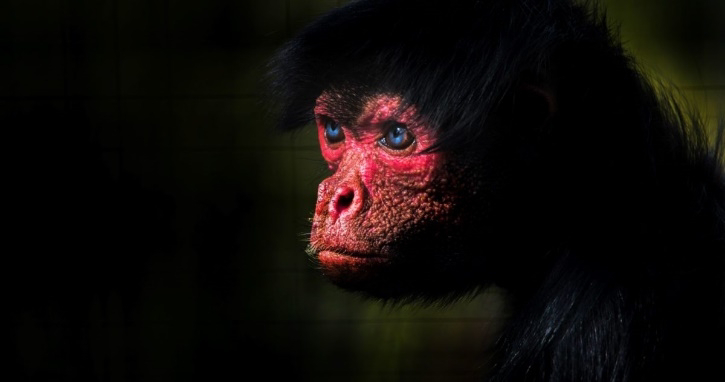
Spider monkeys are found in tropical forests of Central and South America, from southern Mexico to Brazil. There are seven types: Red-faced spider monkey, Black-handed spider monkey, White-bellied spider monkey, Brown spider monkey, Black-headed spider monkey, Peruvian spider monkey, and White-cheeked spider monkey.
They are omnivorous- eat both plants and animals. Their food includes fruit, nuts, seeds, buds, flowers, insects, and eggs. This type of monkey is referred to as frugivores. 80-90 percent of its diet consists of fruits. Sometimes, it eats small reptiles as a major source of protein. Once eaten, its food can travel through the digestive tract in just four hours. 
All male spider monkeys are color blind and 60 percent of females are also color blind. Due to this, they become prey to jaguars, eagles, hawks, and snakes (both venomous and constrictor species). The life span of spider monkeys is around 30 to 40 years.


Credits: Harini

Comments

  1. मनकी (Monkey) बात 👍

    ReplyDelete
  2. Cool, didn't know that they don't thumbs👍🏾

    ReplyDelete

Post a Comment

Popular posts from this blog

WHY ATLANTIC AND PACIFIC OCEAN ARE NOT MIXED?

Nearly 72% of the earth is filled with water and it is present with different names- oceans, seas, rivers. Why are they named differently? There are five oceans namely Artic ocean, Atlantic Ocean, Pacific Ocean, Indian ocean and Antarctic ocean . All the oceans are different in their physical and biological character called ocean clines. When we look at the Atlantic and Pacific Ocean junction, they do not mix. Is there any invisible Wall in between them? Many scientists have conducted research to solve this mystery. The Atlantic and Pacific Ocean have different chemical composition. The salinity of the water in the Atlantic Ocean is five times more than the Pacific Ocean. The density of water is also different, so even marine animals in Atlantic Ocean will not go to the Pacific Ocean. They cannot survive in other oceans. Atlantic and Pacific Ocean meet at Cape Horn. The narrow straight line formed by the water bodies is called Drake Strait. The Pacific Ocean is ...

The Chemical Lake

 Spotted Lake or Lake khiluk in Canada is richly concentrated with various minerals. It contains dense deposits of magnesium sulfate, calcium, and sodium sulfates. It also contains high concentrations of eight other minerals and lower amounts of silver and titanium. Most of the water in the lake evaporates over the summer, revealing colorful mineral deposits. Large ‘spots’ on the lake appear and are colored according to the mineral composition and seasonal amount of precipitation. Magnesium sulfate, which crystallizes in the summer, is a major contributor to spot color.  Originally known to the First Nations of the Okanagan Valley (Native American Tribe) as Khiluk, Spotted Lake was for centuries and remains revered as a sacred site thought to provide therapeutic waters. It is the most mineralized lake in the world. Each spot holds a different cure due to the unique chemical content found within each puddle. Lake Khiluk is considered a saline endorheic alkali lake. The Okanag...

Why is the Pacific Ocean shrinking and the Atlantic Ocean is getting wider?

Twenty million years ago there was no Atlantic Ocean. But then, thanks to plate tectonics, the South American and North American continents were separated by a rift valley that eventually turned into the Atlantic Ocean. The complementary shapes of the South American and African continents have long been noticed, but it wasn't until the 1960s that the theory of plate tectonics became accepted as the explanation. These days, the Atlantic Ocean is growing at a rate of five centimetres per year, as new sea floor is created by volcanic activity along its mid-ocean ridge.        On the other hand, the much older Pacific Ocean is currently estimated to be shrinking by two to three centimetres each year. Again, this comes down to plate tectonics because the Pacific Ocean has subduction zones on three sides - where the Pacific plate submerges beneath other plates.  Since there are very few subduction zones in the Atlantic, Indian and Arctic oceans...